
Framingham City Directory Collections
Historical directory evidence in Framingham sits in several collections rather than one complete run. The Massachusetts State Library inventory identifies individual Framingham city-directory holdings from 1872–1873 through 1956, with many gaps between editions. The Framingham Public Library adds city telephone directories, street lists, maps, and other local material. Each edition is a dated publication snapshot. Record the edition, page, repository, and the wording as printed before connecting it to a family or address.
| Collection | Years | Where Held | Access |
|---|---|---|---|
| State Library Framingham city-directory holdings | 1872–1873 to 1956, selected editions | Massachusetts State Library inventory | Confirm the edition and format with the holding library |
| City telephone directories | 1884–1972 incomplete; 1973–present full | Framingham Room | Noncirculating local-history collection |
| List of Polls and Street Lists | 1920–present | Framingham Room | Use as a dated local resident and street source |
| Framingham High yearbooks | 1931–2024 | Boston Public Library on Internet Archive | Digitized historical school material |
The dates in the State Library list are not a promise of annual publication or a continuous local shelf. Its separate voting-list series has another pattern of years. The library also labels its city telephone run incomplete through 1972, so a missed volume should prompt a check of newspapers, street lists, or the next available directory instead of a claim that nobody was present.
Framingham City Directory Research Room
The Framingham Public Library Local History and Genealogy service is the main local starting point for a historical directory search. The Framingham Room is on the Main Library’s second floor and does not circulate. Reference staff assist during regular hours. Its wider collection includes microfilm, historic photographs, maps, family genealogies, newspapers, yearbooks, local government documents, and oral histories. That combination helps test a directory entry against another source from the same period.
For example, an address printed in a directory can be compared with a street list or a map, while a surname can be checked in a newspaper reel. The current library page describes Framingham Gazette microfilm from 1871 through the present MetroWest Daily News, with some missing years from 1910 through 1930. An older finding aid instead says 1880-present and incomplete. Ask staff to confirm the exact reel before treating a negative newspaper search as meaningful.
See the library’s local-history service before arranging a visit or research request.
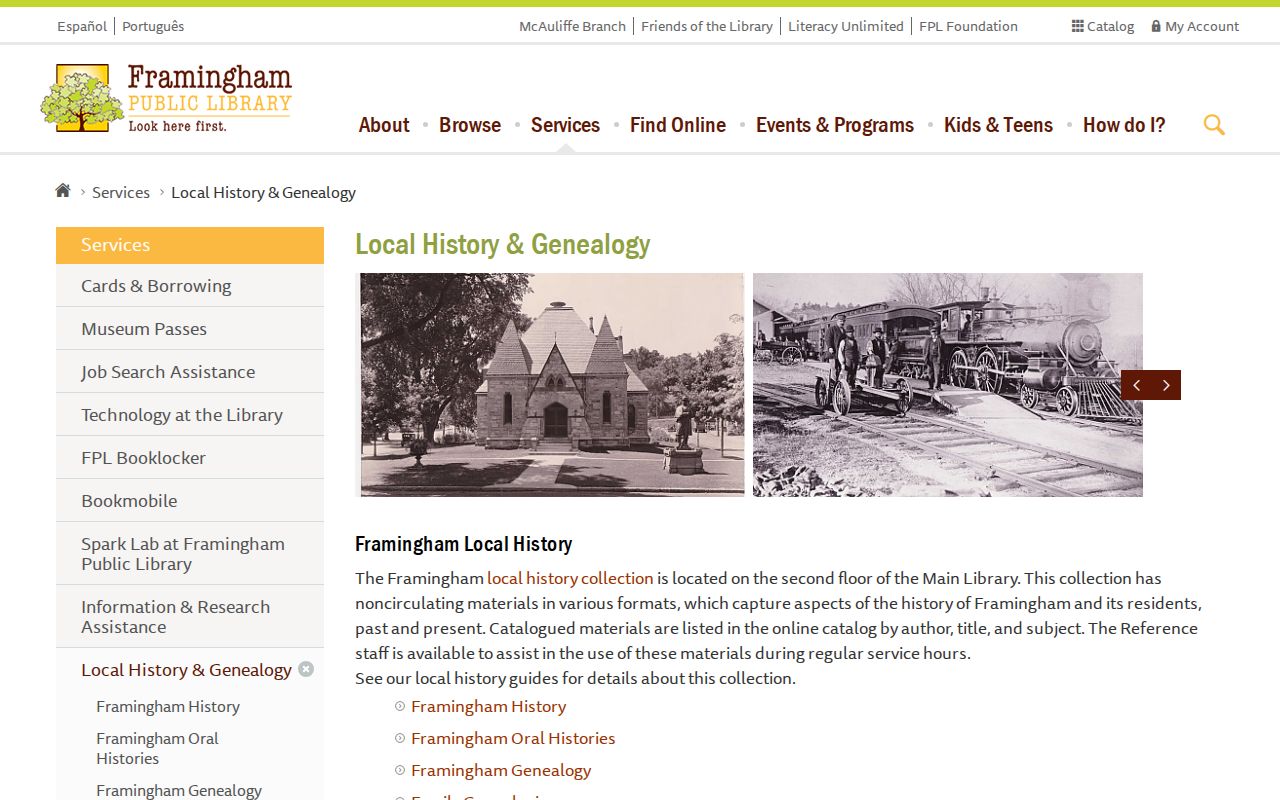
The library image shows the local-history access point that supports a Framingham historical-directory search alongside microfilm, yearbooks, and other dated sources.
Note: Ancestry is available in the library, while HeritageQuest is online for Framingham residents and includes census images and local-history books.
Framingham City Directory Years and Gaps
The State Library inventory is especially useful for setting realistic expectations. It lists Framingham editions for 1872–1873, 1884–1887, 1889, 1900, 1902, 1905–1906, 1908, 1911–1912, 1914, 1916, 1918, 1920, 1924, 1926, 1930–1931, 1933, 1935, 1939, 1941, 1943, 1946, 1950, and 1956. Asterisks attached to several later entries belong to the inventory itself, so the library should verify their format or microfilm status.
Those intervals make a calendar of evidence, not a seamless account of a household. A person’s first appearance may be later than their move, and a last appearance may be earlier than their departure. Pair directory dates with the federal census, released on a 72-year schedule, and with the Framingham Room’s Street Lists. The result should be described precisely, such as “printed at this address in the 1931 edition,” rather than as an undated statement about a person.
| 1700 | Framingham’s town incorporation provides the earlier municipal setting for local records. |
|---|---|
| 1861–present | The city’s Historical Records page describes Annual Town/City Reports in this span. |
| 1888 | The organization now known as the Framingham History Center began as the Framingham Natural History and Historical Society. |
| 2018 | The city charter took effect, while earlier town-era material remains part of the local record trail. |
Interpreting Framingham City Directory Entries
A Framingham city directory entry should be transcribed only from the page in hand. The research inventory confirms that directories may contain a surname or name, address, occupation, and sometimes a street-list-style entry, but no particular scanned entry was inspected for this project. That limitation matters. Do not supply a spouse, owner mark, widow notation, or abbreviation meaning unless the edition actually prints it and the volume’s key supports the reading.
| Edition and page | Identify the year, printed page, and holding repository first. |
|---|---|
| Name | Copy the surname and given name exactly, including initials and spelling variants. |
| Address | Preserve the number and street as printed, then compare it with maps or Street Lists from the period. |
| Occupation | Record it only when the directory prints it; it is historical context, not a current claim. |
| Household or street context | Note any resident or address-order feature visible in that specific edition. |
- Criss-cross directory
- An address-order portion of a directory, if a volume includes one, used to locate printed entries by street rather than surname.
- Householder index
- An index organized around the named household contact, when supplied by a particular publication.
- Abbreviation key
- The publisher’s legend, often near the front matter, that should be checked before expanding a shortened word or mark.
Write down the full citation as you work. A clipped name without its edition, page, and repository is hard to verify later, especially when Framingham’s historical collections have known gaps.
Framingham City Directory Companions
Directories become stronger when paired with sources that answer a different question. The genealogy collection lists maps from 1699, 1832, the 1895 atlas, and other periods, along with cemetery records, church material, civic-group files, and local family collections. Library of Congress Sanborn maps can show footprints, use, and street setting, but they do not create a complete list of people. A map can confirm that a road or structure existed without proving that the directory entry belongs to every person at that location.
The Framingham High yearbooks provide historical school and community context. The library says 84 volumes have been digitized, including North and South high-school material. A yearbook photograph or name should remain a dated school record. Similarly, newspaper material can add an obituary date or civic event, but it needs its own citation and may contain an error.
For present-day address-keyed property work, use the Framingham street directory rather than extending an old directory entry into a current conclusion.
Trace a Framingham Household by Year
A household trail works best as a series of dated observations. Start with a person’s approximate name and year, then keep the original spelling and address in a research ledger. The goal is not to turn several records into one broad label. It is to learn what each source says at its own date and to leave room for a move, a changed street number, a missing edition, or another person with a similar name.
- Locate the surname in the nearest available Framingham directory edition and capture the year, page, and exact text.
- Check the next available edition forward or back, recording each printed address separately rather than assuming a continuous stay.
- Consult a Street List or telephone directory in the Framingham Room when the question is an address rather than a surname.
- Pair the local directory date with the matching released federal census and note the census enumeration date.
- Use a newspaper, cemetery record, probate index, or map only to answer the specific gap it can document.
A disappearance can mean a move, death, a changed listing practice, an omitted issue, or a name variation. Compare the next source before deciding which explanation fits. This measured approach is more useful for family history than a long undated name list.
Framingham’s 1888 Historical Collections
The Framingham History Center research service offers another route when a historical directory needs institutional or neighborhood context. The Center began in 1888 and holds the Dennison Manufacturing Archives from 1844–1990, along with local materials that can explain a company, civic group, street, or period. Its inquiry form asks for a name, email, subject, and inquiry. Independent research is listed at $5, while staff-assisted work is listed at $25 per hour.
The collections also include difficult records, including four bills of sale for enslaved people and a deed concerning Native displacement. Those items should be read through the repository’s context, not mined for isolated names. They show why historical research can involve property, law, and identity in ways a city directory alone cannot explain.
Use the History Center’s research inquiry route when a known box, series, date range, or purpose can make a request more focused.
The inquiry screen supports a Framingham historical directory project by preserving the subject, date range, and repository trail behind a historical question.
Framingham City Records Beyond Directories
Some local questions need a targeted city record instead of another historical directory. The Framingham Historical Records collection lists Annual Town/City Reports from 1861-present, Town Selectmen from 1700–2017, City Mayors and Councilors from 2018-present, Town/City Clerks from 1700-present, and Zoning Board filings from 1939–2013. These materials can document civic roles, local actions, or a building matter at a particular time. They do not establish a current personal address.
A narrow Framingham public-record request can ask for a defined record type, department, date range, and format. Massachusetts Public Records Law uses MGL c.66, with exemptions under MGL c.4 §7 cl.26. City guidance notes that an agency should respond within ten business days, and a requester can ask for an estimate and for nonexempt portions when redactions are needed.
Review the city’s public-record request route before submitting a focused historical inquiry.
The request page is a useful fallback for a defined Framingham historical record, while the library and History Center remain the first stops for directory research.
Note: Ask for the narrowest useful record class and date range, then preserve the custodian’s response with the directory citations.