
Sources for Framingham Previous Residents
Different sources answer different parts of an address history. The Middlesex South Registry can document a recorded transfer, while the Framingham Room’s street lists and directories can place a printed household or business at an address in a dated edition. Federal census schedules describe an enumerated household, not necessarily a street-number match in every period. Maps show a road, footprint, or surrounding land use. The strongest trail states the source type and date beside each observation.
| Source | Years It Covers | Where Held | What It Shows |
|---|---|---|---|
| Middlesex South Registry deeds and plans | Most twentieth-century deeds are described as digitized; circa 1900 or older may require Cambridge research | Middlesex South Registry | Recorded parties, instruments, legal descriptions, dates, and book/page links after image inspection |
| Framingham Room Street Lists | 1920–present | Framingham Public Library | Dated local street and resident listings |
| City telephone directories | 1884–1972 incomplete; 1973–present full | Framingham Room | Printed telephone and address context by edition |
| State Library city-directory holdings | 1872–1873 through 1956, selected editions | Massachusetts State Library inventory | Historical names, addresses, and sometimes occupations as printed |
| Federal census | 1790–1950 public release | National Archives and library research databases | Household information at an enumeration date |
| Historic maps | 1699, 1832, 1856, 1875, 1889, 1895, and 1908 sources | Digital Commonwealth, Boston Public Library, and map collections | Road, parcel, building, and place context |
Start with the era you can name. A recent property question may begin with the assessor and Registry, then move backward. An early family question may begin with a map, city directory, Street List, or census. The Registry’s public page does not establish one precise online cutoff for every series, so avoid assigning a hard first year to the digitized index.
Framingham Previous Residents Start by Address
Use the address exactly as each source prints it. First normalize the current mailing form through USPS, then use the Framingham assessor or MapGeo to identify the parcel and M-B-L. Those property tools can show an assessment owner field, fiscal-year data, sale metadata, and a book/page reference. They do not prove that a named person occupied the parcel. A multi-unit or commercial parcel needs even more caution because the assessment field can belong to an entity or another mailing location.
Next, search the Registry by town and property, or by book/page when the parcel card supplies one. For past residents, keep a simple source ledger: the search mode, address spelling, person or entity name as printed, record date, source URL, and what the result actually establishes. That log makes it easier to recognize a spelling change, a renamed road, an unindexed book, or a gap in a directory.
Note: A dated directory entry, assessment card, and recorded deed are separate record classes and should never be treated as interchangeable proof.
Framingham Previous Residents and Deed Chains
The Middlesex South Registry of Deeds covers Framingham and is the title source for recorded-land research. Its portal offers recorded-land and registered-land searches by name, document, book, property, and recorded date, plus plans and unindexed property search for Books 1–1024. Search by town can narrow a result, but a party name might be a lender, trustee, attorney, corporation, grantor, or grantee. Open the legal instrument before deciding what a listed name means.
- Find the parcel through the assessor or MapGeo, and retain its M-B-L, book/page reference, sale date, and fiscal year as property metadata.
- Open the Registry search for Framingham and find the instrument by property, book, or other stable reference.
- Inspect the deed image for the parties, instrument type, execution and recording dates, consideration if stated, legal description, and prior book/page reference.
- Search the earlier seller as a grantee, then inspect the older instrument and repeat the dated chain backward.
- When the trail approaches circa 1900 or earlier, check both recorded and registered land and plan a Cambridge-office visit if the online trail is incomplete.
- Grantor / grantee
- The grantor conveys an interest in an instrument; the grantee receives the stated interest.
- Chain of title
- A dated series of recorded instruments used to follow legal interests in a parcel over time.
- Legal description
- The parcel-identifying language in a deed, often more stable than a street number in older research.
Family transfers and inherited title can appear through probate rather than an ordinary sale. If the sequence stops, check the alternate land system, plans, probate, and the Registry office instead of forcing an owner list from one partial index.
Framingham Previous Residents on Historic Maps
The Framingham historic-home research guide gives a practical route for checking whether an address and structure existed in a given period. Search MACRIS by city and street without a house number, then download the inventory PDF if a record appears. Framingham warns that those inventory forms began in the 1970s, may be older or incomplete, and can vary in how they state a number. A missing exact number is not a reason to dismiss a plausible street result.
Compare the guide’s suggested maps: 1699 and 1832 Digital Commonwealth maps, the 1856 Boston Public Library wall map, and 1875, 1889, 1895, and 1908 sources. Each can place a road, building, or local label in time. The 1889 source misspells Framingham as “Framington,” a useful search quirk for map catalogs and OCR results. A map can support place history but does not identify a full household on its own.
Use the city’s historic-home workflow as the source for this map-and-MACRIS sequence.
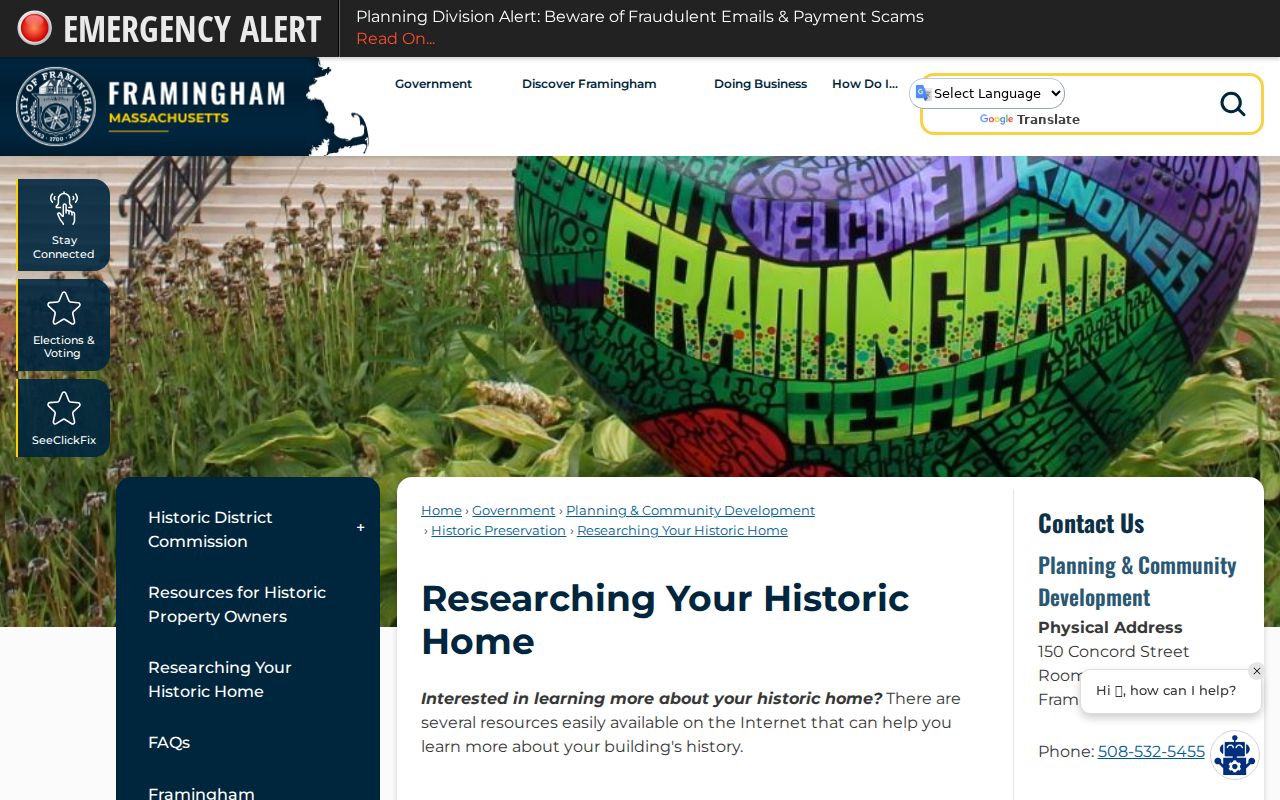
The city workflow connects a Framingham previous-residents search to maps, MACRIS, directories, deeds, and other source types without treating one result as complete proof.
Framingham Previous Residents in Street Lists
For occupants and households, move from property records to the Framingham Room’s dated local publications. The library’s genealogy guide identifies early twentieth-century List of Polls and Street Lists with residents from 1920-present, city telephone directories from 1884–1972 incomplete and 1973-present full, newspapers, maps, cemetery material, family collections, and directories. These are historical snapshots. A printed name can show that a publication associated a person or business with an address in that edition, not that the association continued afterward.
Framingham’s city-directory collections are described in more detail on the Framingham city directory page. Here, use them as one piece of an address sequence. Search the surname and the street when the collection permits both approaches. Keep the original address form in your notes because units, directional words, road names, subdivisions, and postal conventions can change.
Review the Framingham Public Library local-history service before asking staff about a known date, obituary, newspaper item, or Street List.
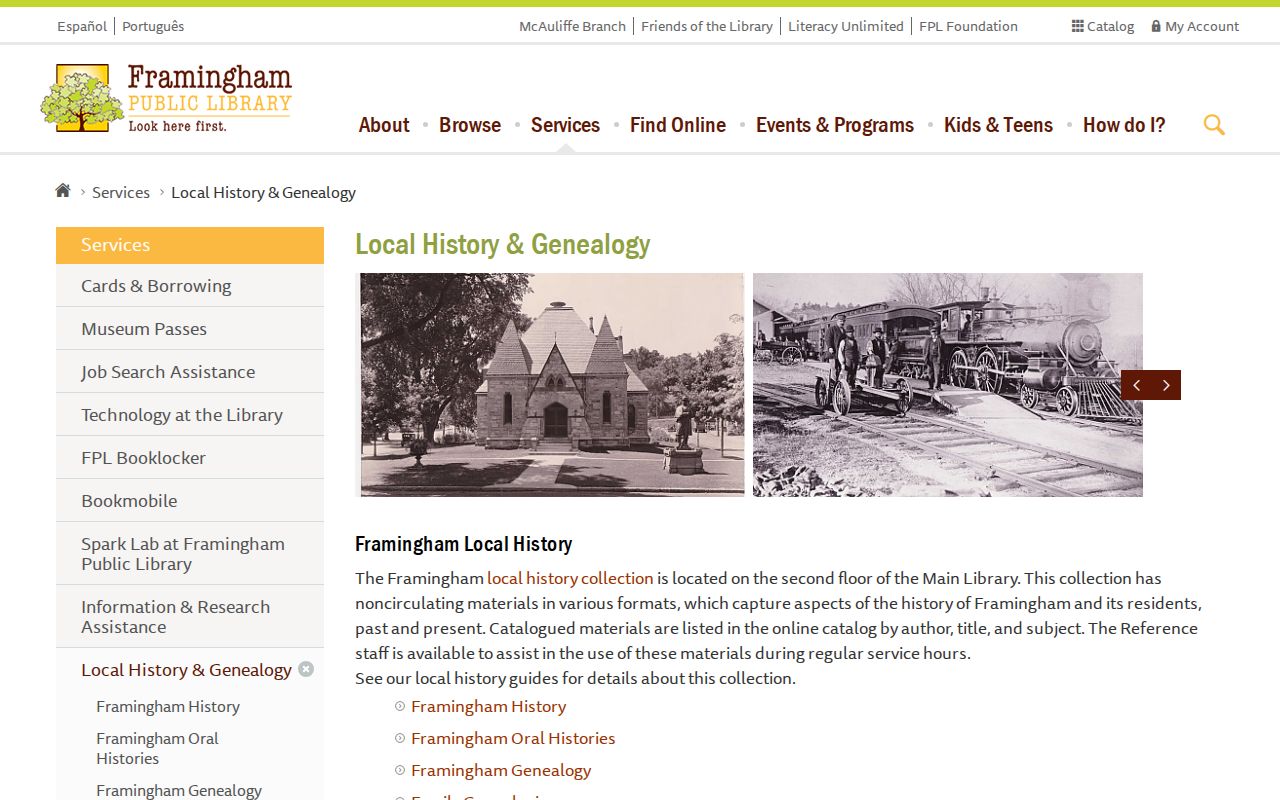
The Framingham Room image represents the local collection where street lists, directories, microfilm, maps, and yearbooks can corroborate an address trail.
Pair Framingham Previous Residents With Census
Directory and census research works as a timed pair. A directory records what its publisher printed for an edition. A census describes a household at its enumeration date. Begin with the closest directory year, then move to the released census and compare the address, names, ages, and relationships only as the records show them. If the spelling changes, look for a matching map, Street List, newspaper, or deed reference before merging the entries.
Use this address-to-household flow: address and approximate year → Street List or directory edition → released census → newspaper or obituary date → probate or cemetery lead when relevant. The Framingham Public Library says staff may search remotely for an article or obituary when the date is known. Its live page describes Gazette microfilm from 1871 with some gaps in 1910–1930, while an older finding aid begins at 1880. Confirm the exact reel before using a negative result.
A person leaving a directory can reflect a move, death, a changed name, an omitted issue, or an editorial difference. Preserve that uncertainty until another dated record resolves it.
Framingham Previous Residents After a Last Address
When the local address trail ends, probate, cemetery, and obituary material can help explain a transition without turning it into a current-person search. Middlesex historical probate sources include first-series indexes, dockets, and files from 1648–1871, second-series file papers from 1872–1886, and indexes from 1870–1949 through the Massachusetts Archives and related access routes. A probate file may document an estate transfer or family connection, but an impounded record is not remotely available.
The Framingham Room lists cemetery records and maps for Edgell Grove, Edwards, Old Burial Ground, St. George’s, St. Tarcisius, and South Burying Ground/Old South, each with its own date range. The city reports no public online interment database; its cemetery office uses an internal database for many historical requests. A cemetery record is a dated end-of-life or burial clue, not proof of the person’s address at every earlier or later point.
Lawful use. Previous-resident research is suited to Framingham house history, family history, estate questions, and personal curiosity. Massachusetts criminal-harassment and stalking laws include MGL c.265 §§43 and 43A; never use a historical trail to pursue or contact a living person.
Framingham House-History Record Gaps
A property’s physical history may be documented in permit, zoning, and archive materials even when a directory cannot answer the question. Framingham’s current OpenGov workflow has handled Inspectional Services, City Clerk, Licensing, Public Works, Public Health, and Fire functions since July 1, 2025. The older portal remains relevant for earlier material. City Historical Records include Zoning Board filings from 1939–2013. A focused request should name the street, number, parcel, document type, and date window.
The city cautions that a Building/Wire archive file exists only if material was submitted with a permit, and digitization is incomplete. Plot-plan retrieval is listed at $30. A plot plan is not a survey, so it should not settle a boundary question. Treat permits as evidence of a submitted project or building change, then compare them with the deed chain and maps before drawing a conclusion about who lived there before.
Note: The old and current permit routes cover different periods, so record which portal or archive supplied each item.
Framingham’s 1888 Archive Trail
The Framingham History Center can add context to a well-defined previous-residents question. Founded in 1888, it offers a research inquiry form for a name, email, subject, and inquiry, and holds the Dennison Manufacturing Archives from 1844–1990. Independent research is listed at $5, and staff-assisted research is listed at $25 per hour. State the purpose, date range, and known box or series when making a focused request.
The Center’s holdings also include records concerning Native displacement and four bills of sale for enslaved people. These are difficult sources that deserve their full archival context. They can explain how property and identity intersected in local history, but they should never be reduced to detached names in an address chronology.
Submit a focused request through the History Center research route when a repository search can clarify a dated local event or institution.

The research form supports a Framingham previous-residents inquiry by documenting the subject, purpose, date range, and archive contact in one place.